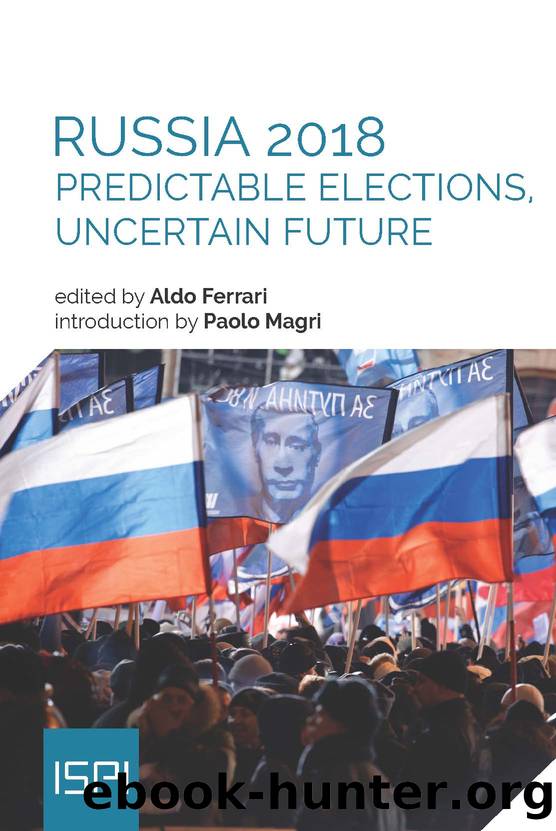
Russia 2018: Predictable Elections, Uncertain Future by Aldo Ferrari
Author:Aldo Ferrari [Ferrari, Aldo]
Language: eng
Format: epub
Tags: Campaigns & Elections, Political Science, Political Process
ISBN: 9788867057078
Google: ouKLDwAAQBAJ
Publisher: Ledizioni
Published: 2018-03-28T13:36:41+00:00
5. Russiaâs Quest for Economic Independence
Philip Hanson
In Britain, Brexiteers say they aim to âtake back controlâ. A similar sentiment lies behind much of contemporary Russian economic policy. The Brexit campaign has specific targets: above all, replacing EU regulation with British regulation. Russian economic policy has a broader range of aspirations: from import substitution through severe limits on external debt to national control over IT systems. But the similarities in underlying motivation are strong. Brexiteers and Russian advocates of economic sovereignty share a suspicious view of foreigners and a readiness to sacrifice or deny the existence of benefits from existing patterns of international economic integration.
In the Russian case, a suspicious view of at least some foreigners is understandable. Moscow is after all subject to sanctions imposed by the US, the EU and a number of other countries from 2014. But several of the âfortress Russiaâ elements in Russian economic policy pre-date sanctions. Economic sovereignty is a long-standing preoccupation in Russia, even though the official Strategy of Economic Security was reformulated only in 2017150 (O strategii 2017; the previous version dates from 1996).
The first section of the paper outlines the definition and coverage of economic security in Russian policy. Subsequent sections are devoted to the main components of the strategy: limiting public debt; limiting the economyâs sensitivity to the oil price; limiting dependence on foreign technology by import substitution; raising the domestic economic growth rate. The final section contains conclusions about the prospects of faster growth â perhaps the most important aim of an economic security policy â after the 2018 presidential elections.
Economic sovereignty and economic security in current Russian official thinking
The key idea in Russian policy statements on economic sovereignty is that Russia must minimise its vulnerability to outside influences. In 2006, Vladislav Surkov, then a Deputy Head of the Presidential Administration, introduced his notion of sovereign democracy by saying that Russia wished to cooperate with other nations âaccording to just rules and not to be managed from outsideâ151 (emphasis added).
These outside influences might come from deliberate actions targeted at Russia, such as sanctions, or they might be the result of the undirected working of markets. The frequently-expressed distaste for Russia becoming a âraw material appendageâ (pridatok) of the West suggests the latter fear. This distaste is as much an expression of wounded pride as of economic anxiety, but the fear that primary producers have less control over their own fates than advanced and diverse economies seems to play a part.
In July 2015, the Russian Security Council instructed the Ministry of Economic Development to draft a new Economic Security strategy152. Nearly two years later, after inter-departmental vetting and amendment, the new doctrine on economic security appeared153. In it, the definition of economic security is given as âthe preservation of national sovereignty by defence against internal and external [economic] threatsâ154. The reference to internal threats is, at first sight, an anomaly. It becomes clear later in the document, however, that domestic sources of economic weakness are treated as threats to Russiaâs economic security, along with external influences.
Download
This site does not store any files on its server. We only index and link to content provided by other sites. Please contact the content providers to delete copyright contents if any and email us, we'll remove relevant links or contents immediately.
| Anthropology | Archaeology |
| Philosophy | Politics & Government |
| Social Sciences | Sociology |
| Women's Studies |
The Secret History by Donna Tartt(19085)
The Social Justice Warrior Handbook by Lisa De Pasquale(12190)
Thirteen Reasons Why by Jay Asher(8907)
This Is How You Lose Her by Junot Diaz(6885)
Weapons of Math Destruction by Cathy O'Neil(6279)
Zero to One by Peter Thiel(5801)
Beartown by Fredrik Backman(5751)
The Myth of the Strong Leader by Archie Brown(5507)
The Fire Next Time by James Baldwin(5442)
How Democracies Die by Steven Levitsky & Daniel Ziblatt(5218)
Promise Me, Dad by Joe Biden(5153)
Stone's Rules by Roger Stone(5087)
A Higher Loyalty: Truth, Lies, and Leadership by James Comey(4960)
100 Deadly Skills by Clint Emerson(4924)
Rise and Kill First by Ronen Bergman(4788)
Secrecy World by Jake Bernstein(4752)
The David Icke Guide to the Global Conspiracy (and how to end it) by David Icke(4717)
The Farm by Tom Rob Smith(4507)
The Doomsday Machine by Daniel Ellsberg(4490)
